Alligatorweed (Alternanthera philoxeroides)
Synonyms: Bucholzia philoxeroides, Telanthera philoxeroides, Achyranthes philoxeroidesCommon Names: Alligator weed, pig weed, alligator grass
Description:
Alligatorweed (Alternanthera philoxeroides) is a water-loving plant from South America that forms thick, tangled mats over ponds, ditches, and shorelines [1][2]. It reached the United States around 1897, probably in ship ballast water, and has spread across the warmer southern states, where its mats crowd out native plants and choke waterways [1][2]. MISIN tracks it because it spreads from the smallest broken piece of stem and is very hard to remove once it takes hold, so catching it early matters [2].
Habit:
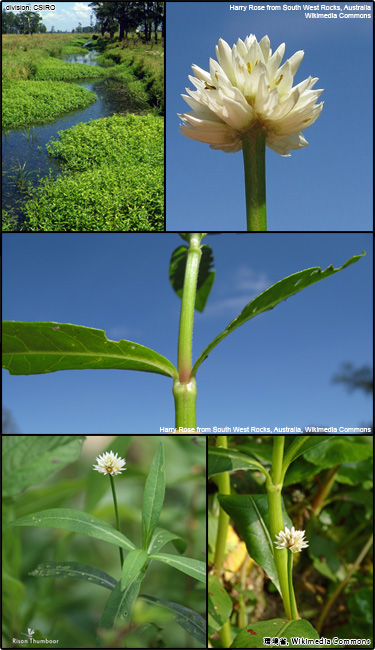
Alligatorweed is a sprawling, mat-forming plant that grows in three ways: as a floating mat over open water, rooted in the shallows along a shoreline, or creeping across wet ground [1]. Its stems are hollow and root wherever a joint touches soil or mud, so a patch keeps widening [1][2]. The leaves grow in opposite pairs, are elliptic to lance-shaped with a clear midrib down the center, and are thick but not fleshy, reaching up to about 4 inches long [2]. The easiest clue is the flower: a small, round, white head that looks like a tiny ball of white clover, held on a short stalk rising from where a leaf meets the stem [1][2].
Alligatorweed is easiest to spot in summer, when it produces its white clover-like flower heads and its mats are thickest at the water's edge [1][2]. Watch all three zones ? open water, the shallow shoreline, and wet mud ? since the plant can grow in each [1].
At-a-glance cues:
- Hollow stems that sprawl and root at the joints, forming dense mats [1][2]
- Opposite, elliptic leaves with a prominent midrib, up to about 4 inches long [2]
- Small, round, white clover-like flower heads on short stalks in summer [1][2]
- Grows as a floating mat, along the shoreline, or creeping on wet ground [1]
Leaves:
- Arrangement: opposite (in pairs) along the stem [2]
- Shape: elliptic to lance-shaped, with a pointed tip and a prominent midrib [2]
- Texture: thick but not succulent (not fleshy or watery) [2]
- Size: up to about 4 inches (10 cm) long and roughly 3/4 inch wide [2]
- Color: green, smooth [1]
Stems:
- Habit: sprawling, mat-forming herbaceous (non-woody) perennial, growing up to about 3 feet (1 m) [2]
- Stems: hollow, single or branched, often pinkish at the base [2]
- Rooting: roots readily at the stem joints where they touch soil or mud, so fragments establish easily [1][2]
- Growth forms: floating mats over water, rooted plants in shallow water, or creeping mats on wet ground [1]
Flowers:
- Color: white [1][2]
- Shape: small, round, ball-like heads that resemble white clover [1][2]
- Arrangement: each head on its own short stalk, rising from where a leaf meets the stem [1][2]
- Bloom time: summer [2]
Fruit and seeds:
- Seed: in its US range, alligatorweed does not produce significant viable seed [1]
- Spread instead: by pieces of stem ? any fragment with a joint can root and grow into a new plant [1][2]
- Dispersal: fragments cling to boats, trailers, nets, and equipment, and float to new water [1][2]
Habitat:
Alligatorweed grows in and along still or slow-moving fresh water. Look for it on the margins and surface of lakes, ponds, ditches, canals, slow streams, and wetlands, and on the wet ground and mud nearby [1][2]. It can root in shallow water and grow out across the surface as a floating mat, or spread over saturated soil on land, which lets it occupy a wide range of wet spots [1].
The plant is native to South America ? Argentina, Brazil, Paraguay, and Uruguay [1]. In North America it is an introduced invader, most widespread across the warm southern United States, and it has spread to more than 30 countries worldwide [1]. In the colder MISIN region it is a watch species ? the goal is to find and report it early, before it can establish [2].
Reproduction:
Alligatorweed spreads by broken pieces of itself, not by seed. In the United States it does not make meaningful viable seed; instead, any fragment of stem with a joint can root and grow into a whole new plant [1][2]. Those fragments cling to boats, trailers, nets, and other gear, and float to new water, so the plant moves easily from one waterbody to the next [1][2]. The most common way it reaches a new pond, though, is people ? moving water, mud, or plants, or dumping aquarium or water-garden plants into the wild [1][2].
Because any fragment can start a new infestation, the most important "control timing" is really prevention: never move the plant or contaminated water and gear [2]. Once it is established, careless cutting or raking can make things worse by scattering fragments that take root downstream [2].
Impact and Damage:
Alligatorweed is not known to be poisonous to people or pets ? the harm is to water and wildlife [1]. For a pond owner, it can take over a backyard pond or ditch, covering the surface and shallows with a thick mat that is hard to clear and that comes back from any piece left behind [1][2].
In natural waters the impacts are serious. Alligatorweed forms dense floating and shoreline mats that crowd out native water plants and lower the variety of life in a pond or wetland [1][2]. As the thick growth shades the water and breaks down, it can pull oxygen out of the water, which harms fish and the insects and other small animals that live there [2]. The mats also block water flow and drainage and make swimming, boating, and fishing difficult [1]. In the southern United States, the alligatorweed flea beetle (Agasicles hygrophila) and other introduced insects have helped control it in what is often called the first successful biological control of an aquatic weed [1].
Similar species:
Sessile joyweed (Alternanthera sessilis) is a close relative in the same genus and the most likely look-alike, with similar paired leaves and small white flower heads. You can tell them apart because sessile joyweed's flower heads sit directly against the stem with no stalk, while alligatorweed's heads are raised on a short stalk.
Smartweeds and knotweeds (Persicaria species) are wetland plants that also sprawl along shorelines and can form mats. They differ in having alternate (not paired) leaves, a thin papery sheath wrapping the stem at each joint, and flowers in slender spikes rather than round clover-like heads.
Monitoring and rapid response:
Signs to watch for:
- Dense mats of sprawling, hollow-stemmed plants with paired, midrib-veined leaves on a pond, ditch, or shoreline [1][2]
- Small, round, white clover-like flower heads on short stalks in summer [1][2]
- Mats growing out over the water surface or creeping across wet mud, regrowing quickly after disturbance [1][2]
What you can do:
- Prevention is the most important step. Never dump aquarium or water-garden plants, water, or mud into ponds, ditches, or storm drains ? that is how new infestations start [1][2].
- Clean, drain, and dry boots, waders, nets, boats, trailers, and fishing gear before moving between waterbodies, since a single fragment can start a new patch [1][2].
- If you think you have found it, do not rake, cut, or chop it, which scatters fragments and spreads it further ? instead, photograph it and report it (below) so experts can confirm it and plan a safe response [2].
- For a small backyard pond, removal must be careful and complete, capturing every fragment; partial removal usually fails because the plant regrows from the pieces left behind [1][2].
- Natural area crews should treat any new find as a rapid-response priority, contain the site to prevent fragment spread, and coordinate with the state aquatic-invasive-species program before attempting removal [2].
When to call a professional:
- Any suspected infestation in a pond, lake, ditch, or wetland ? because this plant spreads so easily from fragments and is so hard to remove, contact your state aquatic-invasive-species program before taking action [2].
- For chemical control options, contact a licensed applicator or your local cooperative extension office.
Report sightings to MISIN. Help track this species' spread by submitting observations through the MISIN web site or the MISIN mobile app (Android, iOS, Windows, and macOS). Photos at multiple angles paired with a precise GPS location are the most valuable data for confirming new occurrences and triggering rapid-response review.
Credits:- USDA National Invasive Species Information Center. Alligatorweed. invasivespeciesinfo.gov
- U.S. Fish & Wildlife Service. Alligator Weed (Alternanthera philoxeroides) Ecological Risk Screening Summary. fws.gov
- California Invasive Plant Council. Alternanthera philoxeroides Profile. cal-ipc.org
Common Name: | Alligatorweed |
Scientific Name: | Alternanthera philoxeroides |
Family: | Amaranthaceae (Amaranth) |
Duration: | Perennial |
Habit: | Aquatics |
USDA Symbol: | ALPH |